We are all unique as individuals, and no two bodies are the same. That means within a Pilates class you’ll find a diverse range of people of all different shapes, sizes, flexibilities and fitness levels.
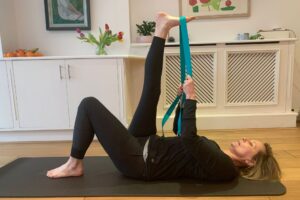
While we keep the fundamentals of a Pilates movement the same, one way we can adapt Pilates mat exercises for individuals is by using props or small equipment. It’s a fantastic way of:
- making an exercise more challenging
- making an exercise easier or giving a little help where needed
- providing more stability where needed
- challenging your stability to make an exercise harder
- changing the focus of an exercise
- adding more variety to an exercise
- helping with rehab from an injury or medical condition
- making Pilates more fun!
As you can see, just a small prop can have a huge impact on the exercises we do and how you find a Pilates session – whether your aim is to make things easier, harder or just to have a little more fun with things.
There are a few different props that can be used in Pilates, some of which were developed by Joseph Pilates himself like the magic circle, to much more recent additions such as the exercise band, softball, small ball, and foam roller.
So, let’s explore what Pilates props are and what they can do for you.
Magic Circle
There’s a bit of a legend with the magic circle. It was developed by Joseph Pilates who used one of the metal circles from a beer keg for his exercises! Thankfully, we have cushioned versions to use in our Pilates classes today.
The magic circle can provide gentle to moderate resistance and muscular feedback in an exercise to correct your form and add some variety to Pilates mat exercises.
Foam Roller
The foam roller is a much-loved prop in Pilates and seems to have become a trendy item in recent years with many high street stores and pharmacies now selling them.
The foam roller offers an unstable surface which makes it great for challenging the core and balance in Pilates movements. Most of my clients enjoy lying on a roller and releasing the tension, especially around their back and shoulder area.
Balls
I think the softball is probably my clients’ favourite piece of kit in Pilates, which is often used as a substitute for the magic circle. It’s much softer than the magic circle, feels nicer and is more forgiving in terms of resistance. This does make it less challenging than the magic circle, but it’s also affordable and easy to pop into a bag for travelling with.
Small balls can be used for muscle and fascia release, and they come in a great range from humble tennis balls to spiky and pinky balls. They’re a particular favourite of mine for foot exercises and they often make an appearance in my Pilates for feet workshops.
The Swiss ball (also known as a gym or fitness ball) is the big ball you can sit on that you often see in the corner of a fitness studio, or in a physiotherapist’s room. I rarely use Swiss balls as they take quite a lot of space to store but they are great for creating a challenging Pilates workout and are often used in the NHS for physiotherapy and birthing preparation courses.
Exercise band
Another prop that made its way into Pilates sessions via physiotherapy, exercise bands come in a range of different strengths to provide different levels of resistance to either make your body work harder or make the exercises easier.
The great thing about the exercise band is that it can be used to mimic exercises done on the Pilates reformer with the band replacing the springs of the reformer, so it’s ideal if you can’t attend a Pilates reformer session.
Small weights
We only use small and light weights because it’s Pilates and not weight training we’re doing. Rather than building muscle, the aim is to make sure you stay in alignment and avoid stress at the neck, shoulders and back.
The purpose of the weights is to add extra challenge and improve your focus on the positioning of the body. Small weights can also help with proprioception and are often used in Pilates rehab for this purpose.
So, there you have it, a whistle-stop tour of the props we tend to use in Pilates classes. How many have you tried, and which is your favourite? If you’re yet to give Pilates props a go, why not start now with a local or online Pilates class?